




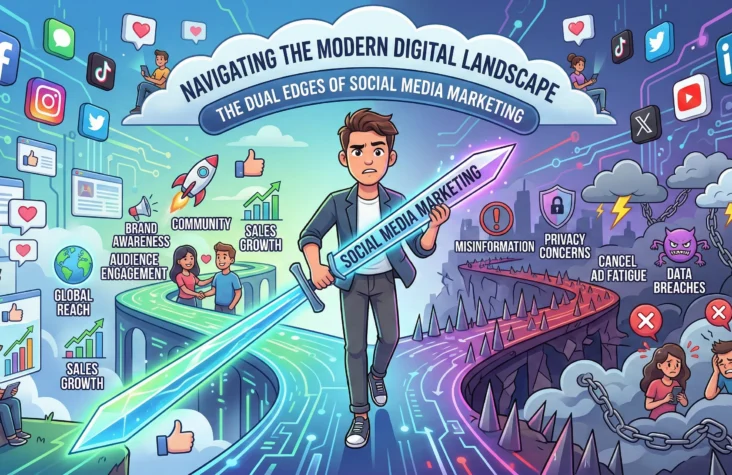
The Dual Edges of Social Media Marketing
The Dual Edges of Social Media Marketing

In the ever-evolving ecosystem of digital marketing, social media has transitioned from a mere networking utility into the central nervous system of modern business strategy. As we navigate the complexities of the current digital landscape, social media marketing is no longer just about posting visually appealing content; it is an intricate dance of data analytics, conversational commerce, and real-time brand management.
For digital marketers, social media platforms offer unprecedented access to global audiences and granular targeting capabilities. However, this immense power does not come without its perils. Today’s marketers operate in a volatile environment shaped by algorithmic unpredictability, artificial intelligence disruptions, and escalating cybersecurity threats.
To build a sustainable digital strategy, marketers must thoroughly understand the dual edges of this sword. Here is a deep dive into the profound benefits and the critical threats that define social media marketing today.
The Undeniable Benefits of Social Media Marketing
When leveraged with a strategic, data-driven approach, social media serves as a catalyst for exponential business growth. The benefits extend far beyond vanity metrics, directly impacting the bottom line and long-term brand equity.
1. The Rise of Conversational Commerce
The traditional sales funnel has been entirely disrupted. We have moved beyond the days when social media merely drove traffic to an external website. Today, platforms serve as end-to-end shopping ecosystems. Through integrations like TikTok Shop, Instagram Checkout, and WhatsApp Business, brands are engaging in “conversational commerce.” This allows consumers to discover, evaluate, and purchase products without ever leaving the app. For marketers, this means reduced friction in the buyer’s journey, higher conversion rates, and the ability to turn a casual direct message into a measurable transaction.
2. Hyper-Targeted Advertising and Granular Analytics
Traditional advertising often relies on a “spray and pray” approach, but social media marketing offers surgical precision. Marketers can leverage vast troves of consumer data to segment audiences based on demographics, psychographics, browsing behavior, and past purchasing history. Furthermore, real-time analytics allow marketers to monitor campaign performance minute by minute. If an ad creative is underperforming, it can be paused or optimized instantly, ensuring a higher Return on Investment (ROI) and eliminating wasted ad spend.
3. Establishing Unshakable Brand Authority
Social media is the ultimate stage for thought leadership and brand storytelling. By consistently publishing high-quality, value-driven content—such as infographics, industry insights, and behind-the-scenes glimpses—brands can humanize their corporate identity. This two-way communication channel fosters a loyal community. When a brand actively responds to comments, addresses concerns, and engages with user-generated content, it builds a foundation of trust that traditional, one-way media cannot replicate.
4. Agile Crisis Management and Customer Service
Consumers now expect immediate responses, often bypassing traditional support emails in favor of X (formerly Twitter) or Instagram direct messages. A robust social media presence allows marketers and customer service teams to address grievances publicly and swiftly. Resolving a customer’s issue in the public eye not only salvages that specific relationship but also proves to thousands of onlookers that the brand is accountable, transparent, and customer-centric.
4. Shift from Keywords to Topic Clusters
The days of cramming exact-match keywords into a blog post are long gone. Today’s algorithms understand context, semantic relationships, and search intent.
Instead of writing ten shallow articles targeting ten different keywords, build a Topic Cluster. Create one massive, comprehensive “Pillar Page” about a broad topic (e.g., Digital Marketing Automation), and hyperlink it to several smaller, deeply detailed “Cluster Pages” (e.g., Email Automation Workflows, CRM Lead Scoring). This internal linking structure signals to search engines that you are an absolute authority on the broader subject.
The Emerging Threats Facing Modern Marketers
Despite its massive potential, the social media landscape is fraught with sophisticated risks. Marketers must pivot from playing pure offense to developing strong defensive strategies to protect their brands.
1. The “AI Slop” Epidemic and Content Homogenization
The democratization of Generative AI tools has revolutionized content creation, but it has also birthed a severe side effect: the market is being flooded with low-effort, AI-generated content. As platforms become saturated with identical, soulless copy and imagery, feeds are becoming crowded with what industry experts term “AI slop.” For marketers, the threat is homogenization. It is becoming increasingly difficult to stand out in a sea of automated noise. Brands that rely too heavily on AI without injecting authentic, human-centric storytelling risk losing their credibility and alienating their audience.
2. Algorithm Volatility and Diminishing Organic Reach
Social media algorithms are constantly shifting, increasingly influenced by AI integrations that make visibility rules opaque and unpredictable. What guarantees viral reach today might result in a shadowban tomorrow. Marketers face the constant threat of having their organic reach slashed overnight due to an unannounced platform update. This volatility forces businesses into a “pay-to-play” model, driving up customer acquisition costs and making it dangerous to rely solely on one platform for traffic and lead generation.
3. The Industrialization of Misinformation
Perhaps one of the most alarming threats to brand reputation today is the rapid spread of misinformation and fake news. With deepfake technology and automated bot networks becoming cheaper and more accessible, malicious actors can easily fabricate controversies or manipulate brand narratives. A single viral piece of fake news—whether it is a deepfake of a CEO or a fabricated product defect—can cause catastrophic damage to a brand’s reputation in hours. Marketers must now function partly as crisis communicators, constantly monitoring social listening tools to defend their brand’s truth at scale.
4. Cybersecurity and Data Privacy Risks
As social media platforms become deeply integrated with business operations, they become prime targets for cyberattacks. The emergence of “Agentic AI”—autonomous AI systems that can plan and execute cyberattacks without human intervention—has escalated the threat level. From hijacked social media accounts to sophisticated phishing scams targeting community managers, the risks are severe. A compromised social media account can lead to data breaches, the distribution of malware to followers, and a complete erosion of consumer trust.
Conclusion: Mastering the Balancing Act
For the modern marketer, succeeding in social media marketing requires a delicate balancing act. The platforms offer unparalleled opportunities to drive revenue, build communities, and establish industry authority. Yet, the rapid advancement of technology means that marketers must remain hyper-vigilant against algorithmic shifts, the loss of authenticity, and sophisticated cyber threats.
To thrive in this environment, marketers must adopt a strategy rooted in agility and authenticity. By leveraging data responsibly, prioritizing genuine human connection over automated mass production, and maintaining robust crisis management protocols, businesses can harness the full power of social media while shielding themselves from its inherent risks. In today’s digital arena, the most successful brands are those that remain technologically advanced, yet fundamentally human.
Looking to elevate your brand’s organic visibility? Explore the rest of my portfolio to see how I translate these cutting-edge SEO strategies into measurable growth.